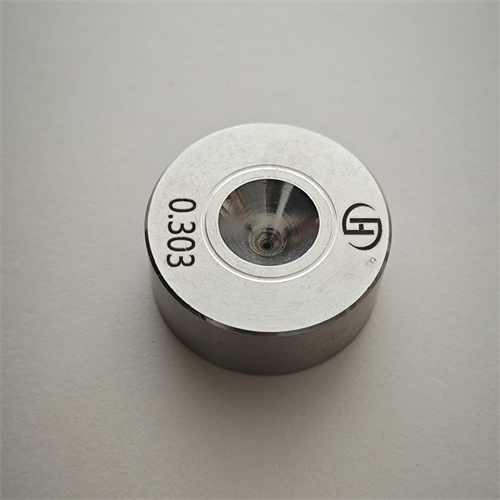
Compared with hard alloy molds, using PCD drawing molds has the following obvious advantages:
High drawing efficiency. The necessary maintenance of the PCD Wire Drawing Dies during use is very important for the service life of the drawing die and the surface quality of the wire. It is usually recommended that customers maintain the polycrystalline diamond drawing die every 24 hours. Within this period, the aperture of the PCD drawing mold undergoes minimal change, and the rate of change in the diameter of the drawn wire is also very small. For the entire production process, the wire diameter compression rate of each PCD drawing die remains relatively stable, resulting in a large ratio of input to output. Additionally, Increased Length Wire Drawing Dies can further enhance efficiency by reducing the frequency of die changes.
Good wear resistance and long service life. The lifespan of polycrystalline diamond drawing dies is approximately 30 to 50 times that of hard alloy dies. This longevity means there is no need to frequently stop and replace the dies during the drawing process. The aperture of the polycrystalline drawing die experiences minimal change per unit time, ensuring that the size of the drawn wire remains consistent. This consistency is highly beneficial for winding the wire onto a roll, as the number of winding turns of the drawn wire is generally fixed. If the size of the finished wire product were to increase rapidly, causing the number of winding turns to decrease quickly, it would necessitate constant changes to the size of the reel, which is detrimental to production efficiency. Furthermore, Cemented Carbide Drawing Dies, while not as durable as PCD, also offer improved wear resistance compared to hard alloy dies.