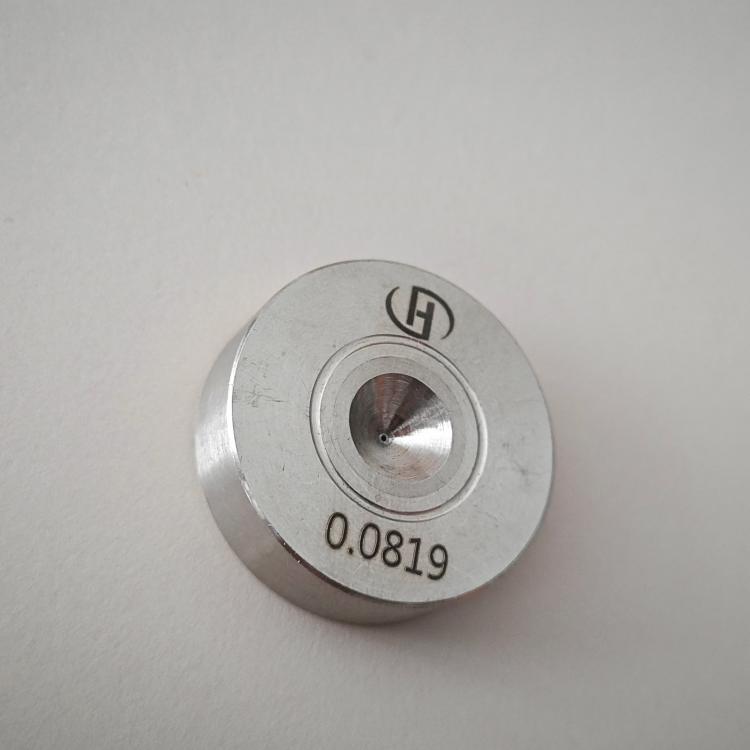
You're running your high-speed line at 2,000 meters per minute. Everything is smooth. Then snap – the wire breaks, coils whip, and you lose an hour of production. You blame the incoming rod, but the culprit is sitting right in your die box.
Here are three PCD wire drawing dies profile errors that cause high-speed wire breaks.
1. Too Short a Bearing Length
The bearing (or "working length") controls wire stability. When your PCD wire drawing dies have a bearing that's too short – say, under 30% of the wire diameter – the wire wobbles as it exits. That wobble creates micro-bending stresses. At high speed, those stresses turn into full fatigue breaks. A good rule: bearing length should be 30-50% of the incoming wire diameter. Measure it with a die scope. You'll be surprised how many cheap dies cut corners here.
2. Abrupt Reduction Angle Transition
The reduction angle is where the wire first contacts the die. If the angle is too steep (over 16 degrees), the wire experiences a sudden compression shock. The surface work-hardens instantly. Then as it passes through the bearing, that hardened zone cracks. Premium PCD wire drawing dies use a gradual entry angle (10-12 degrees) followed by a smooth transitional curve. No sharp corners. That's what separates premium from budget.
3. Wrong Profile for Galvanized Wire
Here's a special trap. Galvanized wire drawing dies need a different profile than bare copper or steel. Zinc coating is soft and smears. If you use a standard PCD wire drawing dies profile designed for bare steel, the zinc builds up on the bearing surface. That buildup pinches the wire, increases friction, and leads to sudden snapping. For galvanized wire, specify a longer approach angle (14-16 degrees) and a shorter bearing with a back-relief taper. This lets zinc particles flush out instead of sticking.
Don't just replace your PCD wire drawing dies blindly. Inspect the profile. If you're snapping wires at high speed, measure the bearing length, check the reduction angle smoothness, and verify you're using galvanized wire drawing dies for zinc-coated material. Otherwise, your "high-speed" line will keep turning into a scrap-making machine. Stop the snaps. Fix the profile first.