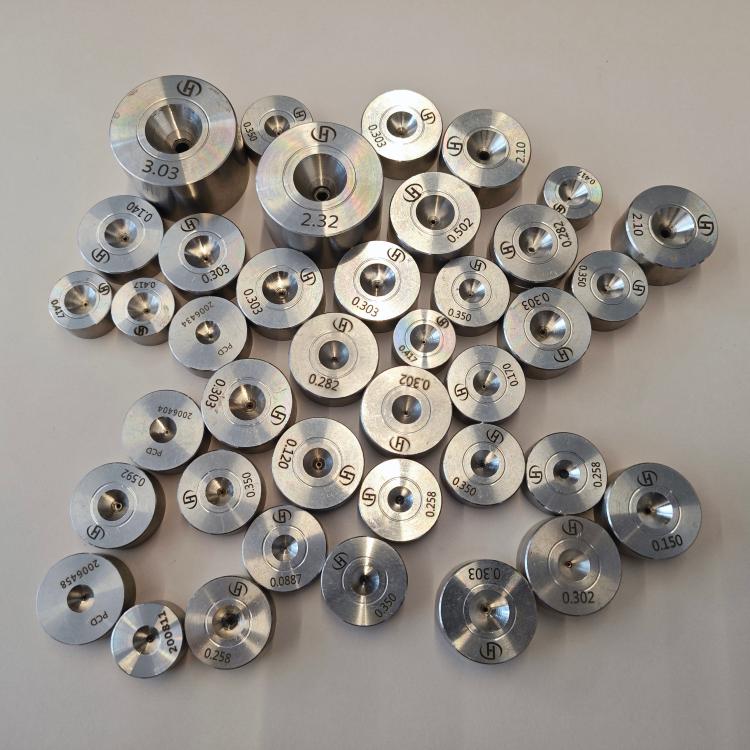
Adjustment 1: Reduce the Approach Angle
Standard stainless steel wire drawing dies often come with a 14-16 degree approach angle. That works for thicker wire. But for fine wire (under 1mm), a steep angle work-hardens the surface too fast. The stainless steel’s austenitic structure hardens aggressively under sudden compression. Result: a brittle outer layer that cracks as it passes through the bearing. Drop the approach angle to 10-12 degrees. The gentler entry lets the metal deform more gradually, and the cracking stops.
Adjustment 2: Shorten the Bearing Length
Fine wire doesn’t need a long bearing. In fact, a long bearing on a stainless steel wire drawing dies creates excessive friction and heat. That heat cooks the lubricant and raises the risk of wire seizure. Switch to a bearing length of 30-40% of the incoming wire diameter (instead of the usual 50-60%). The wire glides through with less drag, and break rates drop dramatically.
What About Other Die Materials?
For ultra-fine stainless wire (under 0.2mm), SMCD wire drawing dies (synthetic monocrystalline diamond) are a better choice than conventional PCD. SMCD has no binder, so it polishes to a mirror finish that reduces friction. Natural diamond wire drawing dies are even better for the finest wires—they handle the high compressive strength of stainless without chipping. But they cost five times as much. For most fine stainless jobs, adjusting the angles on standard dies fixes the snap problem without upgrading materials.
Try these two adjustments on your next die order. You’ll spend less time picking broken wire out of your capstans and more time running profit.