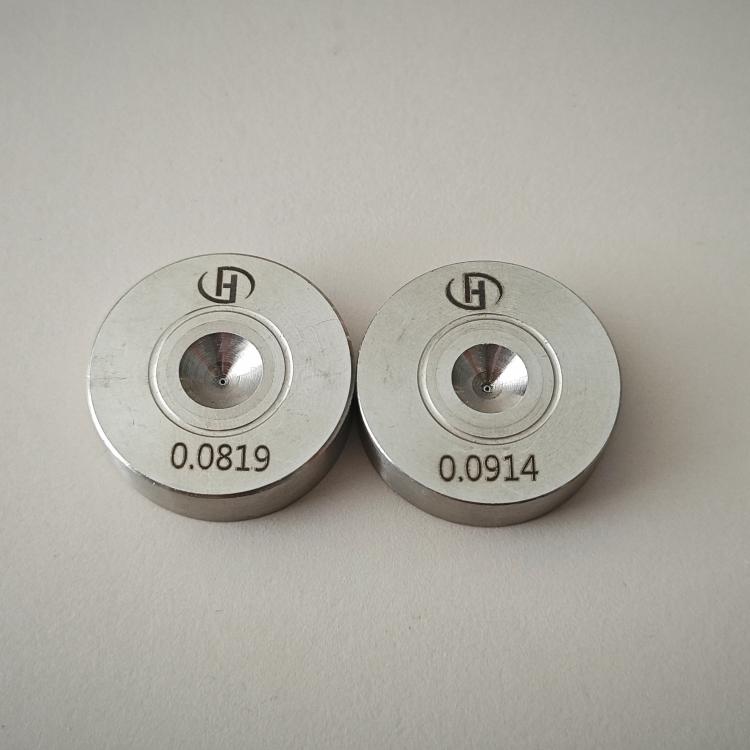
Here's how wire drawing dies fight friction – and why premium PCD wire drawing dies win the battle.
The Friction Zone
The highest friction happens in the bearing section of a wire drawing die. That's where the wire is sized to its final diameter. The wire slides against the die surface under immense pressure. Without careful design, that sliding generates heat, softens the wire, and picks up die material.
Strategy 1: Polished Surfaces
A standard die has a ground finish. Under a microscope, it looks like mountains and valleys. The wire rides on the peaks, creating point contacts with very high pressure. Those peaks generate heat and wear.
PCD wire drawing dies (polycrystalline diamond) can be polished to a mirror finish (Ra 0.02µm or better). The wire glides on a nearly flat surface. Friction drops by 40-60% compared to unpolished carbide dies.
Strategy 2: Optimal Bearing Length
Too long a bearing creates unnecessary rubbing. Too short a bearing doesn't stabilize the wire. Premium wire drawing dies use a bearing length of 30-50% of the incoming wire diameter. That's the sweet spot: enough contact to size the wire, not enough to overheat it.
Strategy 3: Reduction Angle + Lubricant Channel
The reduction angle (where the wire first contacts the die) needs a small "wedge" to pull lubricant into the die. Cheap dies have sharp angles that scrape lubricant away. Premium PCD wire drawing dies use a 10-12 degree approach angle with a polished entry zone. Lubricant flows into the bearing under pressure, creating a hydrodynamic film. The wire rides on lubricant, not on the die.
The Premium Difference
Standard PCD wire drawing dies work well for general use. But premium PCD wire drawing dies add:
-
Nano-polished surface (Ra <0.01µm)
-
Optimized bearing length per wire type
-
Controlled lubrication grooving
-
Finer diamond grain size for less friction
The result? In a head-to-head test on copper wire at 2,000 m/min, a standard PCD die reached 150°C at the bearing. A premium PCD die ran at 95°C. Lower temperature means longer die life, cleaner wire, and higher line speed.
Friction isn't just heat. It's lost profit. Investing in premium PCD wire drawing dies raises your upfront cost but lowers your cost per meter. Less friction, less wear, fewer stops. That's how you win the wire drawing game.