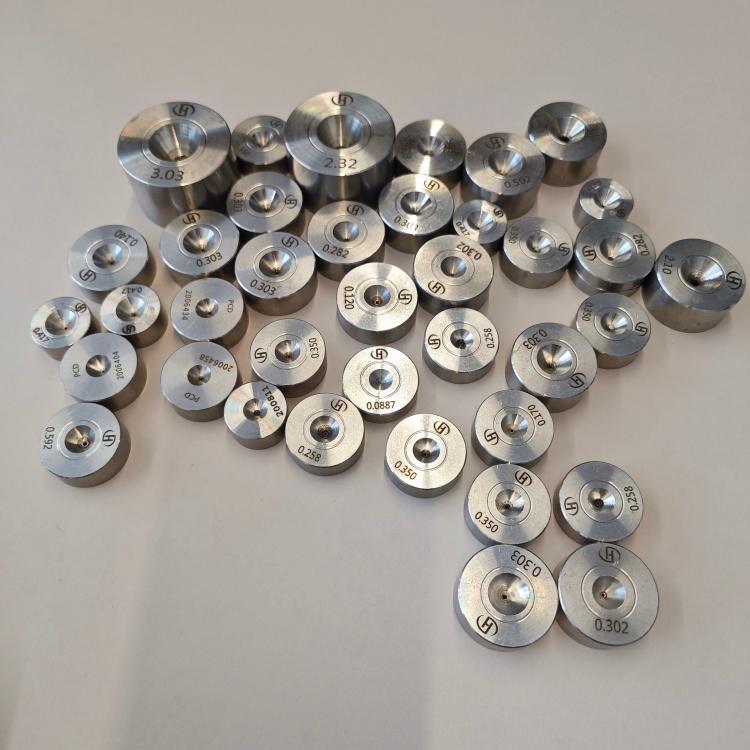
You've got a wire drawing line running 16 hours a day. Your die costs are eating into margins. And you're stuck choosing between tungsten carbide and PCD. Let's do the math for six months – no marketing fluff, just real production numbers.
Start with tungsten carbide dies. Cheap upfront – maybe $30 to $50 each. But here's what your shift supervisor won't tell you: on copper wire, a carbide die wears out after 100,000 to 150,000 meters. You're swapping dies every two to three weeks. Each swap means downtime, rethreading, and scrap ends. In six months, you'll burn through eight to ten carbide dies per strand. Add the labor cost of 15-minute changeovers each time. That $50 die actually costs you closer to $120 after downtime. For ten dies? $1,200 plus frustration.
Now look at PCD wire drawing dies. One die costs $150 to $250. That stings when you buy it. But a good PCD die runs 500,000 to 800,000 meters on copper before you see measurable ovality. In six months of heavy production, you might not even replace it once. Zero changeover downtime. Consistent wire surface from day one to day 180. The math is simple: one PCD die at $200 beats ten carbide dies at $500 plus ten changeovers at $50 each in lost time. That's $200 versus $1,000. PCD pays for itself in the first two months.
But what about nano wire drawing dies? These sit between PCD and natural diamond. Grain size measured in nanometers gives you near-diamond surface finish with PCD toughness. Price around $300. For high-carbon steel or copper alloys with hard inclusions, a nano wire drawing die can outlast standard PCD by 40%. In six months, you might still be on the same die. That $300 pays off if your product demands mirror finish and zero surface defects.
So which one wins in six months? For most copper and aluminum lines, PCD wire drawing dies are the clear winner. They pay back within 60 days. Tungsten carbide only makes sense for short runs or dirty feed stock where you don't want to risk an expensive die. And nano? Keep it for specialty wires where surface quality is king.
Stop changing dies every week. Go PCD. Watch your six-month die budget drop by half.