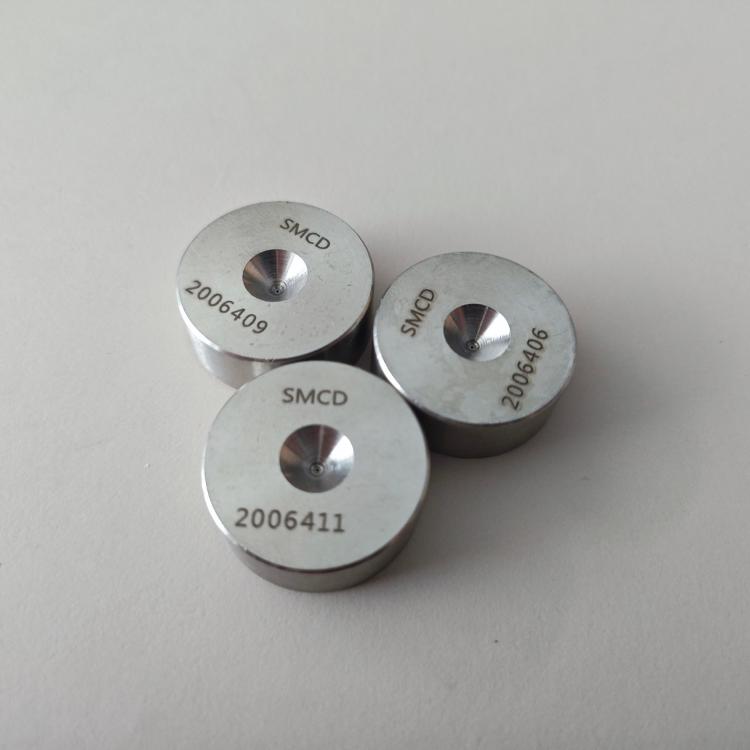
Selecting the correct wire drawing die size is critical for achieving optimal line efficiency, product quality, and cost-effectiveness. This guide explores key considerations for Wire Drawing Dies, SMCD Wire Drawing Dies, and Stainless Steel Wire Drawing Dies, providing actionable insights for manufacturers.
1. Core Principles for Die Size Selection
- Reduction Ratio: The die aperture must align with the target wire diameter and reduction ratio (typically 10–20% per pass). For example, reducing a 7.2mm copper rod to 1.6mm requires multi-pass drawing with calculated die sizes.
- Material Hardness: Stainless Steel Wire Drawing Dies demand harder materials (e.g., SMCD) due to higher abrasion resistance. A 0.5mm stainless steel wire may require a die with 0.02mm wear allowance.
- Industry Standards: Compliance with GB/T 6108.2 ensures dimensional accuracy (e.g., H8–H13 tolerance grades).
2. SMCD Wire Drawing Dies: Precision and Durability
SMCD dies, crafted from synthetic single-crystal diamond, excel in high-precision applications:
- Advantages: Extreme hardness (≥80 GPa), thermal conductivity (2,000 W/m·K), and consistent blank dimensions.
- Applications: Ideal for medical wire, bonding wire (gold/copper), and EDM wire. A 0.3mm SMCD die can achieve >50,000m lifespan in stainless steel drawing.
- Design: <111> crystal orientation ensures predictable wear patterns, minimizing diameter variation.
3. Stainless Steel Wire Drawing Dies: Challenges and Solutions
Stainless steel’s high work-hardening rate demands specialized dies:
- Material Selection: SMCD or polycrystalline diamond (PCD) dies are preferred for 304/316L stainless steel.
- Lubrication: Use phosphate coatings or oil-based lubricants to reduce friction.
- Case Study: A manufacturer reduced die changes by 40% by switching to SMCD for 0.8mm stainless steel wire.
4. Industry Trends and Best Practices
- Simulation Tools: Computer models predict stress ratios and heat generation, optimizing die angles (e.g., 8° vs. 12°).
- Quality Control: Laser micrometers verify post-drawing diameters (±0.005mm tolerance).
- Sustainability: Recyclable SMCD blanks reduce material waste by 30%.