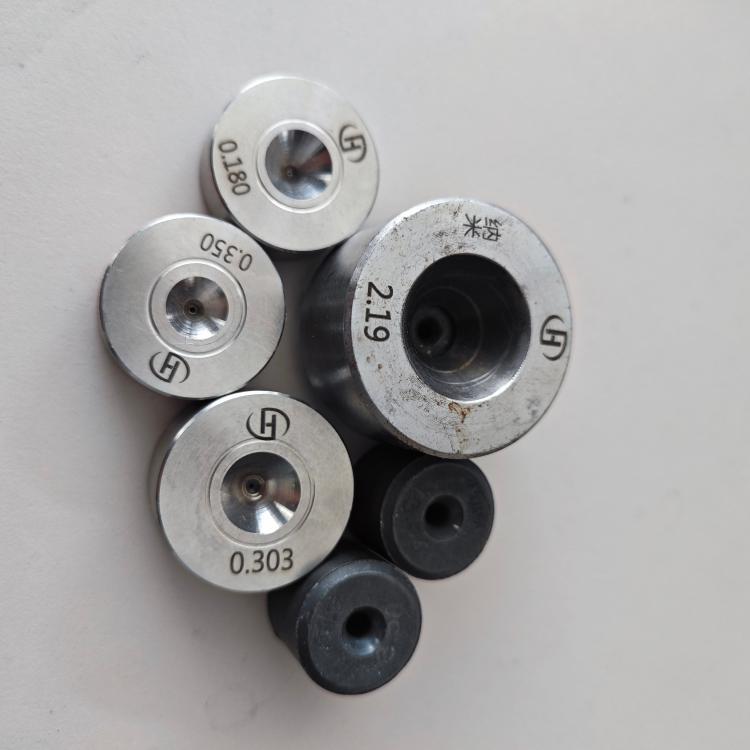
Wire Drawing Dies are critical components in metalworking, shaping raw wire into precise diameters for industries ranging from construction to electronics. Their sizes, typically measured by entrance/exit diameters and bearing lengths, directly impact material efficiency and finished product quality.
Tungsten Carbide Dies dominate the market due to their exceptional hardness (1,500–2,000 HV) and wear resistance. Standard sizes range from 0.10mm to 30.00mm in exit diameters, with bearing lengths optimized for low-friction reduction. These dies excel in processing carbon steel, copper, and aluminum, maintaining ±2μm tolerance even under high-speed drawing. Their robustness makes them ideal for automotive cables and structural reinforcement wires.
Nickel Wire Drawing Dies, designed for corrosive-resistant alloys like Inconel and Monel, feature specialized geometries to handle nickel’s high work-hardening rates. Exit diameters often span 0.05mm to 12.00mm, with polished surfaces minimizing material adhesion. Aerospace and medical industries rely on these dies for ultra-clean wires used in turbine components and surgical devices.
Size selection hinges on material type and reduction ratio. For instance, multi-stage drawing of stainless steel may require progressive dies shrinking from 8.0mm to 0.5mm, while nickel-based superalloys demand shorter bearing lengths to reduce friction heat. Compliance with ISO 4490 and ASTM E384 ensures dimensional accuracy across all sizes.