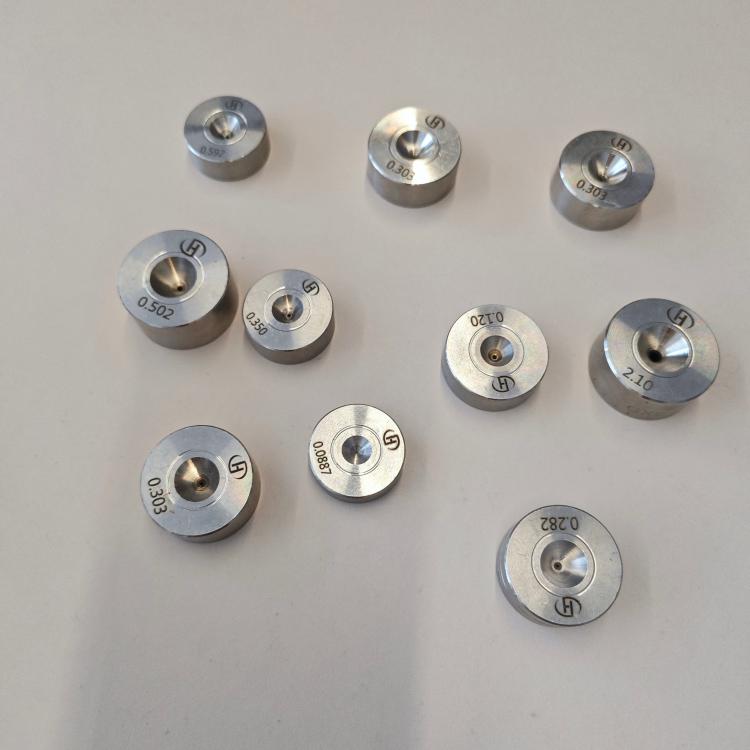
Testing special-shaped wire drawing dies, including Nickel Wire Drawing Dies, requires a structured approach to ensure precision and durability. Below is a step-by-step industry guide:
1. Dimensional & Shape Verification
- Use optical comparators or 3D scanning systems to validate die geometry against design specifications.
- For non-circular profiles (e.g., square, hexagonal), confirm corner radii and edge sharpness (<0.001mm tolerance).
2. Surface Quality Assessment
- Inspect for cracks, pitting, or adhesion marks using scanning electron microscopy (SEM).
- Nickel-based dies demand stricter scrutiny due to their susceptibility to corrosion at elevated temperatures.
3. Material Analysis
- Validate material composition via EDS (Energy Dispersive Spectroscopy) to ensure nickel content meets standards (e.g., ASTM B355).
- Test hardness (Rockwell C scale) and thermal conductivity to predict wear resistance.
4. Performance Testing
- Conduct dry-run trials with target wire materials (e.g., stainless steel, copper-clad steel).
- Monitor parameters like drawing force, back tension, and heat generation using strain gauges and thermocouples.
- For nickel dies, simulate high-temperature conditions (400–600°C) to assess oxidation resistance.
5. Defect Detection
- Identify common issues like bell mouth deformation or bearing surface wear through real-time stress analysis (FEM software).
- Nickel dies often fail due to adhesive wear in the approach zone; use finite element modeling to optimize die angles.
6. Calibration & Maintenance
- Regularly recalibrate dies using laser interferometry to maintain dimensional accuracy.
- For polycrystalline diamond (PCD) special-shaped dies, track wear patterns to predict service life (typically 80,000–100,000 meters).
Industry Insight
By 2025, 72% of manufacturers adopt AI-driven defect detection systems, reducing testing time by 40%. Nickel wire drawing dies, critical for aerospace and electronics, now integrate thermocouple-guided thermal management to prevent overheating.